Multi-Gen Australian Labradoodle vs F1 Labradoodle: Why Generation Matters for Size, Coat & Temperament

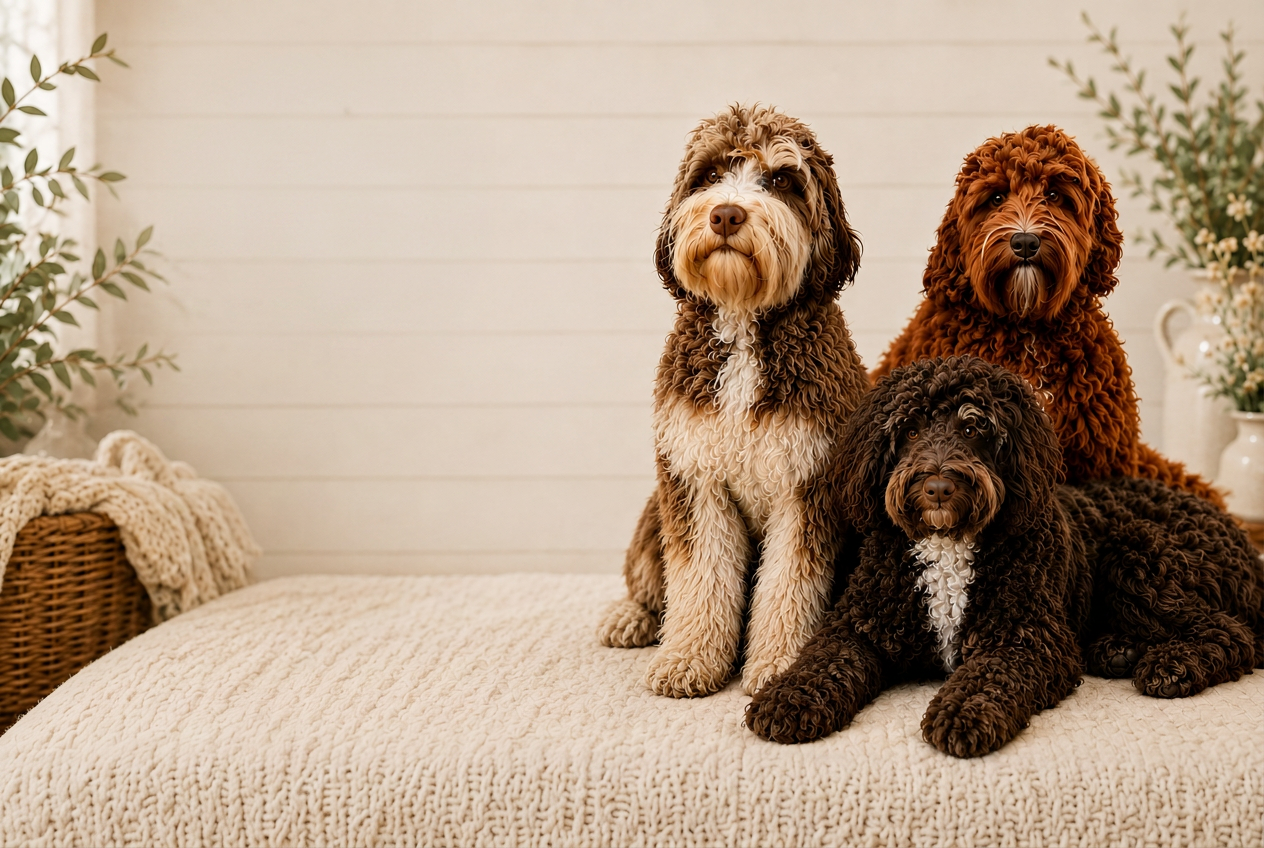
Two doodle puppies sit side by side at 8 weeks old. Both are adorable and healthy. One is an F1 Labradoodle (Lab times Poodle). The other is multi-generational Australian Labradoodle. Fast-forward two years: the F1 weighs 60 pounds with a straight, shedding coat. The Australian Labradoodle weighs 22 pounds with a low-shedding fleece coat and calm temperament. Similar names, wildly different outcomes.

This guide explains the difference between multi-generational Australian Labradoodles and F1 Labradoodles. You'll learn why Australian Labradoodles offer predictable size, coat, and temperament. You'll discover which type fits your family best. You'll see what each generation label means. You'll understand real examples of variation in F1 litters. You'll learn why reputable breeders focus on multi-gen lines.

What is the difference between F1 Labradoodle and multi-gen Australian Labradoodle?

F1 Labradoodle equals first-generation cross (Labrador times Poodle). Genetics are unpredictable. Size varies 30 to 65 pounds within same litter. Coat can be straight and shedding, wavy, or curly. Temperament ranges from high-energy Lab to anxious Poodle.

Multi-generational Australian Labradoodle equals Australian Labradoodle times Australian Labradoodle (5+ generations of selective breeding). These are not F1 crosses. Predictable traits include size consistent within 3 to 5 pounds of parents. Fleece or wool coat provides minimal shedding. Calm, even temperament bred for therapy and service work.

Australian Labradoodles cost more ($3,000 to $4,000 versus $1,500 to $2,500 for F1 Labradoodles). This reflects decades of health testing and selective breeding.

Labradoodle Generations Explained: F1, F1B, and Multi-Gen Australian Labradoodle

F1 Labradoodle (first generation) means Labrador Retriever times Poodle. This creates 50/50 genetics with most variation. Puppies in one litter can look completely different.

F1B Labradoodle (first-generation backcross) means F1 Labradoodle times Poodle. This creates 75% Poodle genetics. Shedding improves but results still vary unpredictably.

F2 and F3 Labradoodles mean F1 times F1 or F1B times F1B. Genetics still remain unstable. These are not multi-generational despite being second or third generation.

Multi-generational Australian Labradoodle (Australian Labradoodle times Australian Labradoodle) means minimum 5+ generations. All Australian Labradoodles are multi-generational. Traits become predictable through selective breeding. Both parents carry consistent genetics.

Australian Labradoodle is a distinct breed from Labradoodle. Foundation lines include Labrador, Poodle, Cocker Spaniel, Irish Water Spaniel, and Curly Coat Retriever. These breeds were added beyond just Lab plus Poodle.

F1 Labradoodle: Lab times Poodle creates low predictability. Typical use includes pet homes and budget option.

F1B Labradoodle: F1 times Poodle creates moderate predictability. Typical use includes allergy families seeking less shedding.

Multi-gen Australian Labradoodle: Australian Labradoodle times Australian Labradoodle creates high predictability. Typical use includes therapy, service, and predictable pet homes.

Size Predictability: Why F1 Labradoodle Litters Vary So Much

F1 Labradoodle size variation example: Litter of 8 puppies produces adult sizes ranging 32 pounds to 58 pounds. Breeders cannot predict this at 8 weeks old. Two puppies from the same litter and same parents can differ by 25+ pounds.

Australian Labradoodle consistency works differently. Parents weighing 20 pounds and 24 pounds produce puppies maturing at 19 to 25 pounds. This falls within 3 to 5 pounds of parents.

Families wanting miniature size (15 to 25 pounds) cannot rely on F1 Labradoodle miniature claims. Genetics may produce 40 pound dogs despite miniature label. We've seen families purchase miniature F1 Labradoodle puppies that grew to 45 pounds. This was far too large for their apartment. Multi-gen Australian Labradoodle breeding eliminates that guesswork.

WALA size standards define Australian Labradoodle categories clearly. Miniature equals 14 to 24 pounds. Medium equals 25 to 42 pounds. Standard equals 43 to 60+ pounds. Multi-gen breeders select parent size to meet specific categories.

F1 Labradoodle miniature labels often refer to Poodle parent size. This does not guarantee puppy outcome. A miniature Poodle bred to a Labrador produces unpredictable results.

Coat Type and Shedding: The Biggest Difference

F1 Labradoodle coat variation appears within single litters. Some puppies inherit wavy fleece (low-shedding). Others inherit straight Lab coat (heavy shedding). This happens even within the same litter from the same parents.

Australian Labradoodle coat produces fleece or wool in 95%+ of puppies. Both parents carry consistent coat genes. This creates predictable low-shedding coats across all puppies.

F1B Labradoodle (backcross to Poodle) improves shedding odds but offers no guarantees. Some puppies still inherit straight coat from F1 parent.

Puppy coat does not equal adult coat in F1 Labradoodles. F1 puppies with wavy coats at 8 weeks can develop straight, shedding coats by 10 to 14 months. This creates unpleasant surprises for allergy families.

Multi-gen Australian Labradoodle breeders predict adult coat based on parent coats. F1 Labradoodle breeders cannot make this prediction. We previously owned Goldendoodles that shed far more than our Australian Labradoodles. F1 Labradoodles produce unpredictable coats. Some shed heavily despite one Poodle parent.

F1 Labradoodle coat: Low predictability (varies within litter). Shedding risk reaches 30 to 50% moderate shedding. Best for families with no allergies.

F1B Labradoodle coat: Moderate predictability. Shedding risk reaches 10 to 20% moderate shedding. Best for families with mild allergies.

Multi-gen Australian Labradoodle coat: High predictability (fleece/wool). Shedding risk under 5% moderate shedding. Best for families with allergies or preference for low-shedding.

Temperament: Calm vs. High-Energy or Anxious

F1 Labradoodle temperament range varies dramatically. Puppies can inherit Labrador's boundless energy (needs 2+ hours exercise daily). Or they inherit Poodle's anxiety and reactivity. Or they get a calm blend. Breeders cannot predict which outcome happens.

Australian Labradoodle temperament goal targets therapy and service work. Breeders select for calm, confident, moderate energy, and low reactivity.¹ This creates consistent results across litters.

Australian Labradoodle foundation includes Cocker Spaniel (adds gentleness). Irish Water Spaniel addition reduces anxiety. These breeds were deliberately chosen to improve temperament stability.

Training difficulty varies by type. High-energy F1 Labradoodles require experienced owners. Anxious F1s need behavior modification. Australian Labradoodle temperaments suit first-time owners better.

Reputable Australian Labradoodle breeders use Puppy Culture protocols. They also use temperament testing. This enhances genetic stability. Our Australian Labradoodle puppies consistently score moderate energy and high confidence. We rarely see the extremes common in F1 Labradoodle litters.

Health Testing and Genetic Diversity: Both Matter

Hybrid vigor myth claims F1 Labradoodles are automatically healthier. F1 crosses reduce some purebred risks. However, they don't eliminate hip dysplasia, PRA, or other diseases. Both Labs and Poodles carry these conditions. Hybrid vigor describes increased growth and fitness. It does not prevent genetic diseases.¹

Australian Labradoodle advantage uses decades of OFA and Orivet testing. Breeders remove affected dogs from breeding pools. F1 Labradoodle breeders often skip testing. They rely incorrectly on hybrid vigor claims.

Genetic diversity remains strong in multi-gen Australian Labradoodles. Foundation includes 6+ breeds: Labrador, Poodle, Cocker Spaniel, Irish Water Spaniel, and Curly Coat Retriever. This maintains diversity through multiple ancestral lines.

F1 Labradoodle breeders who skip health testing pass problems to puppies. Hip dysplasia, eye disease, and heart conditions transfer at same rates as poorly bred purebreds.

WALA requires health testing for Australian Labradoodle registration. F1 Labradoodle breeders face no such requirement or oversight. This creates major quality differences.

Which Type Is Right for You? Decision Guide

Choose Australian Labradoodle if you want predictable size, coat, and temperament. Choose Australian Labradoodle if you have allergies. Choose Australian Labradoodle if you're a first-time dog owner. Choose Australian Labradoodle if you want therapy or service prospect.

Choose F1 Labradoodle if budget is your primary concern. Choose F1 if you're flexible on size and coat. Choose F1 if you have no allergies. Choose F1 if you have experience with high-energy or anxious dogs.

Avoid F1 Labradoodle if you need specific size (under 25 pounds for apartment). Avoid F1 if you have moderate to severe dog allergies. Avoid F1 if you want calm family companion.

Questions to ask any breeder: What generation are your puppies? Are they Australian Labradoodles or Labradoodles? Can I see OFA results for both parents? What's the size range in your previous litters?

Red flag: Breeder claims F1 Labradoodle puppies are just as predictable as Australian Labradoodles. Genetics do not support this claim.

Priorities Checklist:

Size predictability (specific weight range needed)

Low-shedding coat required (allergies or preference)

Calm, even temperament (family with kids, first-time owner)

Health-tested parents (long-term vet cost reduction)

Budget flexibility (Australian Labradoodles cost $500 to $1,500 more than F1 Labradoodles)

If you checked 3+ boxes, Australian Labradoodle is better fit. If you checked 0 to 1 boxes, F1 Labradoodle may work for you.

Ready to meet our multi-gen Australian Labradoodle parent dogs? Discover how six generations of careful breeding creates predictable, healthy puppies: Meet Our Parent Dogs

References

¹ Hammack, Stephen P. "Breeding Systems." Texas A&M AgriLife Extension Service Beef Skillathon, beefskillathon.tamu.edu/breeding-systems/.