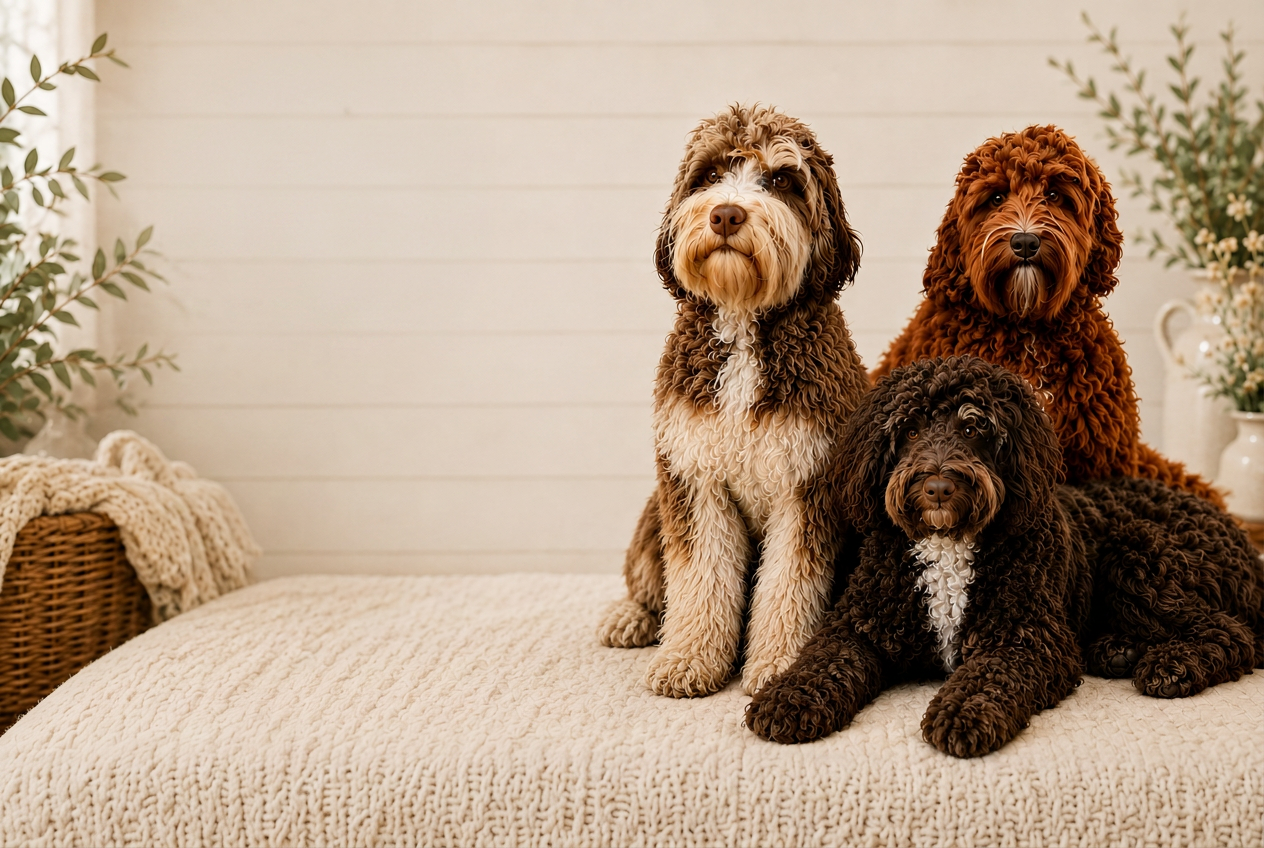
What Is an Australian Labradoodle?

My phone rang on a Tuesday afternoon. The woman sounded tired.

"I've been reading about doodles for six months," she said. "Everyone tells me something different. Some people say Labradoodles are just mutts. Others say Australian Labradoodles are real dogs. I don't know what to believe anymore."

I hear this almost every week.

You've probably been there too. You Google "Labradoodle" and get confused. You see regular Labradoodles. You see Australian Labradoodles. You wonder if there's actually a difference or if breeders just made up fancy names.

Here's the truth: Australian Labradoodles aren't just another mixed breed. They're a carefully planned breed that's been developed for 35 years. And knowing the difference matters when you're choosing a family dog.

It Started With One Woman's Problem

The story begins in 1989. A blind woman in Hawaii needed a guide dog. But her husband was allergic to dogs. Really allergic.

She called the Royal Guide Dog Association in Australia for help. A man named Wally Conran ran their breeding program. He had a problem to solve.

First, Wally tried using Poodles as guide dogs. Poodles don't shed much, so they're better for allergies. Over two years, he tested 33 different Poodles. He sent hair samples all the way to Hawaii.

None of them worked. The husband was still allergic. And the Poodles didn't have the right personality for guide work.

So Wally did something different. He bred a Labrador Retriever to a Standard Poodle. Labs make excellent guide dogs. They're smart and calm. Poodles don't shed. Maybe combining them would work.

The first litter had three puppies. Wally sent hair and saliva samples to Hawaii. Only one puppy worked. That puppy was named Sultan.

Sultan went to Hawaii and became their guide dog. He lived with that family for years. The blind woman could finally have a guide dog. Her husband's allergies were fine.

Problem solved, right?

Not quite. Wally had two other puppies from that litter. Nobody wanted them. In 1989, people thought mixed breeds were cheap dogs. Even though Wally had a waiting list for guide dogs, nobody wanted these "mixed breed" puppies.

Wally needed those puppies raised in good homes. So he made a smart choice. He called the local TV station. He told them about a "new breed" of guide dog. He gave them a catchy name: Labradoodle.

The TV show aired. Within 24 hours, hundreds of people called wanting these dogs.

That's how it started. Not as a fad. As a real solution to a real problem.

Two Women Saw Something Special

Wally bred 31 Labradoodles for the Guide Dog Association. Twenty-nine of them became working guide dogs. That's incredible. Most guide dog programs are happy with 50% success.

But when Wally retired, he stopped breeding. He thought his work was done.

Two Australian women disagreed.

Beverley Manners started a breeding program called Rutland Manor in 1989. Her daughter Angela started one called Tegan Park the same year. Both programs were in Victoria, Australia.

These women had a bigger vision. They didn't just want service dogs. They wanted family dogs. Dogs that anyone could own. Dogs with gentle temperaments and coats that didn't cause allergies.

But they saw a problem. When you breed a Lab to a Poodle, you get surprise puppies. Some look like Labs. Some look like Poodles. Some shed. Some don't. You never know what you'll get.

That's fine for one family's pet. But it's not good enough for a consistent breed.

So Beverley and Angela started breeding Labradoodles to other Labradoodles. Then they bred those puppies to more Labradoodles. Generation after generation. That's called multi-generational breeding.

They also added other breeds carefully. They added Irish Water Spaniels for chocolate color. They added Cocker Spaniels for a gentler personality and smaller sizes. They added Curly Coat Retrievers to bring back some Labrador qualities.

They named these dogs Australian Labradoodles. The name showed they weren't just simple Lab-Poodle mixes. They were something new.

For 35 years now, breeders have kept refining these lines. Every Australian Labradoodle today traces back to those original Australian programs.

If you're looking for a family dog with health testing and a predictable personality, visit our available puppies page to see our Australian Labradoodles.

How Australian Labradoodles Came to America

The Australian breeding programs were working. People in Australia loved these dogs. Word started spreading to other countries.

In the late 1990s and early 2000s, American breeders heard about Australian Labradoodles. They wanted to bring these dogs to the United States.

The problem? Australia has strict quarantine laws. You can't just fly dogs out easily. And importing breeding dogs is expensive and complicated.

But some dedicated American breeders made it happen. They imported dogs from Tegan Park and Rutland Manor. They paid thousands of dollars. They dealt with months of quarantine and paperwork.

Those first imported dogs became the foundation of American Australian Labradoodle lines.

Other American breeders started working with these imported lines. They followed the same breeding standards. They health tested their dogs. They only bred multi-generational Australian Labradoodles to other multi-generational Australian Labradoodles.

The Australian Labradoodle Association of America (ALAA) was founded to protect the breed in the United States. Later, the Worldwide Australian Labradoodle Association (WALA) formed to unite breeders globally.

Today, hundreds of American breeders work with Australian Labradoodle lines. But every single one traces back to those original Australian imports. Our male Ryder's pedigree goes back to both Tegan Park and Rutland Manor on both his mom's side and his dad's side. That connection to the original Australian programs proves he's a real Australian Labradoodle.

Why They're Not Just Mutts

Here's what most people don't understand.

Every dog breed started as a mix. German Shepherds. Golden Retrievers. Labs. All of them began by mixing different dogs together.

The difference between a mutt and a breed is planning and time.

A mutt happens randomly. Two different dogs mate. You get puppies. Those puppies are all different. You can't predict what they'll look like or act like.

A breed follows a plan. Breeders choose specific dogs with good traits. They breed those dogs together. They track family trees. They test for health problems. They do this over and over for many years.

Eventually, the dogs start looking and acting the same. When you breed two of them together, you know what the puppies will be like. That's called "breeding true."

Australian Labradoodles breed true now. When we breed our dogs, we know what we're getting. The puppies look similar. They act similar. Their coats are the same type. No surprises.

That's not a mutt. That's a developing breed.

We Learned This the Hard Way

We used to help raise Goldendoodles. We were guardian homes for a breeder. That means we raised their breeding dogs in our home.

Goldendoodles are usually F1 crosses. That means first generation. Lab mixed with Poodle, or Golden Retriever mixed with Poodle.

Every litter was completely different. Some puppies looked like Goldens. Some looked like Poodles. Some were calm. Some were anxious. Some were hyperactive. You never knew what you'd get.

We loved those dogs. But they weren't the perfect fit for our family.

So we researched. We learned about Australian Labradoodles. We tried one. The difference was clear immediately.

Australian Labradoodles have six or more generations of breeding behind them. Every dog in the family tree is also an Australian Labradoodle. That creates consistency.

When we breed our dogs now, we know what to expect. Every puppy has the same gentle, confident, playful personality. Every puppy has a low-shedding coat. No lottery. No surprises.

That's why we switched from Goldendoodles to Australian Labradoodles. And that's why we only breed multi-generational Australian Labradoodles now.

Ready to apply for an Australian Labradoodle puppy from proven bloodlines? We'll answer all your questions about how multi-generational breeding works.

What Makes Them Special

Australian Labradoodles carry genes from six different breeds. Each breed adds something important.

Labrador Retrievers give them that friendly personality. Labs love people. They're gentle with kids. They want to make you happy. That Lab personality is in every Australian Labradoodle.

Poodles make them smart and give them the low-shedding coat. Poodles are one of the smartest breeds. They learn fast. The Poodle genes create the coat that helps with allergies.

Cocker Spaniels make them calmer and gentler. Cockers are naturally sweet dogs. They helped create smaller sizes too. That Cocker influence is why Australian Labradoodles are so mellow.

Irish Water Spaniels brought chocolate coloring. They also make Australian Labradoodles love water. Many of our dogs love swimming.

Curly Coat Retrievers added back some retriever qualities. They helped create the fleece coat texture.

All six breeds blend together. You're not getting one breed or another. You're getting a careful mix that's been refined for 35 years.

Three Sizes for Different Families

Australian Labradoodles come in three sizes.

Miniature dogs stand 14 to 16 inches tall. They weigh 15 to 25 pounds. These are small dogs perfect for apartments or seniors. They have the same personality as bigger sizes in a tiny package.

Medium dogs stand 17 to 20 inches tall. They weigh 30 to 45 pounds. This is the most popular size. Medium dogs are big enough to play with kids but small enough for most homes.

We breed medium Australian Labradoodles. This size fits Anderson and Indianapolis families perfectly.

Standard dogs stand 21 to 24 inches tall. They weigh 50 to 65 pounds. These are bigger dogs for families wanting a substantial companion.

All three sizes act the same. Size doesn't change personality. A tiny Australian Labradoodle acts just like a big one.

Two Types of Coats

Australian Labradoodles have two coat types. Both are low-shedding when bred right.

Fleece coats feel soft and silky. They can be straight, wavy, or have loose curls. Most Australian Labradoodles have fleece coats. They're easy to brush and maintain.

Wool coats feel dense like lamb's wool. They hang in tight spirals or loose curls. Wool coats need more grooming than fleece but shed even less.

Multi-generational breeding makes these coats predictable. When you breed two fleece-coated parents, their puppies have fleece coats. No surprises.

First-generation Labradoodles can't promise that. You might get three puppies with nice coats and two that shed. It's a lottery.

Australian Labradoodles eliminate that guessing game.

The Personality You Can Count On

Australian Labradoodle temperament is remarkably consistent.

These dogs love everyone. They bond with their families. They're friendly to strangers. They're gentle with kids. They get along with other dogs and even cats.

They're smart without being crazy. They learn commands fast. They want to please you. But they're not anxiously watching your every move like herding dogs do.

They play when it's playtime. They nap when you're busy. That adaptability makes them perfect family dogs.

They're confident without being aggressive. Our puppies don't develop separation anxiety. They handle new things well. They're not easily scared or reactive.

We saw this difference clearly coming from Goldendoodles. Goldendoodles were all over the map. Some were anxious. Some were wild. Some were perfect. You couldn't predict which you'd get.

Australian Labradoodles are the same every time. Every puppy from our program shows that gentle, confident, adaptable personality.

WALA Registration Proves It's Real

When someone says they have "Australian Labradoodles," ask one question: Are they WALA registered?

WALA stands for Worldwide Australian Labradoodle Association. It's the main organization protecting real Australian Labradoodle bloodlines.

WALA keeps a database of family trees. Every registered dog must trace back to the original Australian breeding programs. If a breeder can't prove their dogs go back to Tegan Park or Rutland Manor, they can't register with WALA.

WALA also requires health testing. Member breeders must test their dogs for hip problems and genetic diseases. They must give two-year health guarantees on puppies.

All our dogs are WALA registered. That registration proves they're real. It shows our dogs aren't just Lab-Poodle mixes with a fancy name.

When you research breeders, always ask for WALA registration numbers. If they can't provide them, they're probably breeding first-generation mixes.

When People Call Them Mutts

Someone says "Oh, you breed mutts" at least once a week.

I used to get upset. Now I just explain the facts.

Our dogs have documented family trees going back six generations. Every dog in those family trees is also an Australian Labradoodle. They breed true. They're recognized by WALA and ALAA. They follow breed standards.

That's not a mutt. That's a developing breed.

The American Kennel Club doesn't recognize them yet. But that takes time. Most dog breeds took 50 to 100 years to get full recognition. Australian Labradoodles have only existed since 1989. They're 35 years old. They're babies compared to other breeds.

They're on the path. They're getting there. Meanwhile, they're incredible family dogs with predictable traits and health testing.

Call them whatever you want. The families who own them know what they are.

Why This Matters for You

Understanding what Australian Labradoodles are matters because it affects what you get.

If you buy a first-generation Labradoodle, you're gambling. You might get a wonderful dog. You might get a shedding, anxious dog that doesn't fit your family.

If you buy from someone who says "Australian Labradoodle" but can't show WALA registration or multi-generational pedigrees, you're probably getting first-generation crosses with a fancy name attached.

If you buy a real multi-generational Australian Labradoodle from a WALA-registered breeder who health tests, you get predictability. You know your puppy's adult size. You know their coat will be low-shedding. You know their personality will be gentle. You know their parents were tested for genetic diseases.

That predictability is worth it. It's worth finding a good breeder. It's worth doing your homework.

That confused woman who called me? She bought an Australian Labradoodle puppy from us. Six months later, she sent me a photo. Her daughter with allergies was snuggled up with their chocolate tricolor puppy on the couch.

"I finally get the difference," her text said. "Thank you."

That's why this matters.

FAQ: Are Australian Labradoodles recognized by the AKC?

No, Australian Labradoodles aren't recognized by the American Kennel Club yet. However, they're registered with the Worldwide Australian Labradoodle Association (WALA) and the Australian Labradoodle Association of America (ALAA). These organizations maintain breed standards and family tree databases. Most modern dog breeds took 50 to 100 years to get AKC recognition. Australian Labradoodles have only existed since 1989, so they're still young as a breed.

How much does an Australian Labradoodle cost?

Find out mroe about the cost of an Australian Labradoodle here.

References

¹ Smith, Bruce. "Auburn Veterinary Professor Comments on 'Designer Dogs' and Dog Breeding." Auburn University Office of Communications & Marketing, 1 Oct. 2019, ocm.auburn.edu/experts/2019/10/010117-designer-dogs-breeding.php.